The Hopedale Collection
This page features books by and about Adin Ballou and the Hopedale Community, that are in print and available to purchase for a reasonable price.
Most of them were inspired, written, edited, researched, critiqued, and/or proofread by members of Friends of Adin Ballou.
The Bibliography
lists many more works, which can be found online, at libraries, or on the used book market.
Most of the links on this page are to the paperback and/or Kindle edition from Amazon.com,
but these books are also available from other online retailers.
Any book that is available in a Kindle format can also be obtained in the EPUB format
used by e-readers such as Kobo and Nook.
|
ISBN 978-0981640242
Publisher: Blackstone Editions
Pages: xxxiii + 571
|
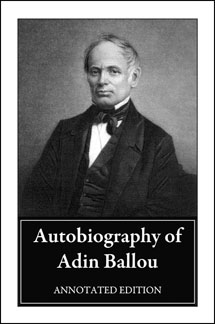
Autobiography of Adin Ballou
Annotated Edition
Adin Ballou was a man of peace -- yet he was not of a naturally peaceful disposition.
As a young minister he engaged in theological controversy so heated that his own party urged him to moderate his language.
Though he never engaged in physical violence, Ballou knew what it was like to become caught up in an exchange of hostilities, to identify with one side and demonize the other,
to feel injured and to wish to injure others in return.
In his autobiography, Ballou tells the story of his transformation from a proud and touchy man, zealous for his own honor and the honor of the causes he espoused,
to a champion of peace, loved and respected in his own Hopedale Community and around the world.
This edition includes more than 800 notes to illuminate the people, places, relationships, literary allusions, religious movements, and popular culture that made up Adin Ballou's world.
Buy the paperback
Buy the Kindle edition
|
|
|
ISBN 978-0-9816402-3-5
Publisher: Blackstone Editions
Pages: xxviii + 339
|
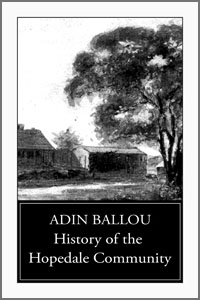
History of the Hopedale Community
Annotated Edition
Adin Ballou
The Hopedale Community was one of the most important and successful of the many utopian communities started in the
mid-nineteenth century United States. In History of the Hopedale Community, community leader Adin Ballou provides a detailed record
of the successes, failures, hopes, and disappointments of a small group of people attempting to live together harmoniously,
in accordance with "their ideal of what human life and human society upon the earth ought to be."
This new edition features a newly restored map of Hopedale, many explanatory notes on the text, and a table of the members,
drawn from the membership records of the community.
Buy the paperback
|
|
|
ISBN 978-0-9725017-1-2
Publisher: Blackstone Editions
Pages: xxxi + 190
|
Christian Non-Resistance
Adin Ballou
In Christian Non-Resistance (1846) Adin Ballou set out his vision of a world in which nations would glory not in military
might but in "superior justice, forbearance, meekness, forgiveness, charity," and beneficent order could be maintained without violence.
Once dismissed as a relic of the naive and sentimental optimism of pre-Civil War America, it is now recognized as
an important contribution to the theory of nonviolent resistance. Ballou's combination of the utmost moral resistance to evil
with the uninjurious physical restraint of evildoers provides a conceptually simple, flexible approach to the problem of resisting
evil without becoming evil oneself.
Buy the paperback
Buy the Kindle edition
|
|
|
ISBN 978-0-9725017-0-5
Publisher: Blackstone Editions
Pages: xxix + 267
|
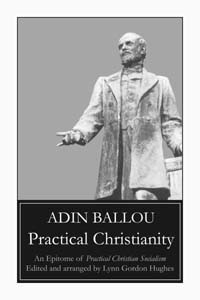
Practical Christianity
An epitome of Practical Christian Socialism by Adin Ballou
Edited and arranged by Lynn Gordon Hughes
Practical Christian Socialism (1854) was Adin Ballou's most comprehensive exposition of his fundamental principles
and their application to personal and community life, ranging from theology and political theory to marriage, child-rearing,
and a surprisingly frank discussion of sexuality.
In Practical Christianity, Ballou's 655-page treatise has been edited to eliminate the cumbersome dialogue form
in which it was originally written. All of the language is Ballou's own, and nothing is omitted except a final section
in which he compared Practical Christian Socialism to competing varieties of utopian socialism.
Buy the paperback
Buy the Kindle edition
|
|
|
ISBN 978-0-9725017-4-3
Publisher: Blackstone Editions
Pages: xii + 83
|
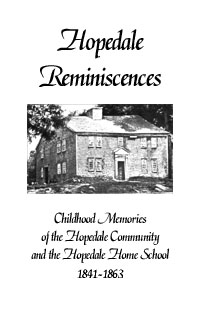
Hopedale Reminiscences
Childhood Memories of the Hopedale Community and the Hopedale Home School, 1841-1863
This little book is devoted to remembering the "good old days" of living in the utopian community of Hopedale, Massachusetts
during the 1840s and 1850s. The pleasures and hardships of living in a village devoted to re-creating society in a non-violent,
cooperative and equitable way are examined, often humorously, through the eyes of its children.
Eleven sketches by people who had been children during Community days were published as Hopedale Reminiscences
in 1910. These sketches form the core of this book.
To this has been added a chapter from the autobiography William F. Draper, the son of Ballou's nemesis George Draper;
the proceedings of a reunion of the Home School from 1867; and a list of the students and faculty of the school.
Buy the paperback
Buy the Kindle edition
|
|
|
ISBN 978-0-9725017-2-9
Publisher: Blackstone Editions
Pages: 32
Hard cover with dust jacket
|
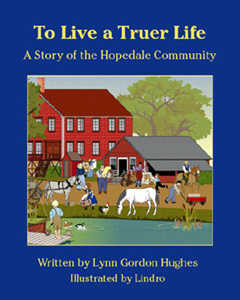
To Live a Truer Life
A Story of the Hopedale Community
Written by Lynn Gordon Hughes
Illustrated by Lindro (Linda Rogers)
Hopedale, Massachusetts in 1855 is a town unlike any other. Everyone who lives there has promised never to kill, hate, or
hurt another human being - not even their worst enemy. There are no rich people and no poor people. Everyone has a job to do,
and everyone shares.
This picture book presents the Hopedale Community through the eyes of one if its youngest members, eight-year-old Susie Thwing.
Her job is to deliver the mail to everyone in Hopedale and sell the special pink Hopedale Penny Post stamps. In this book,
young readers can join Susie as she makes her rounds and shows what makes her town so special.
Buy from the publisher
|
|